Disclosure: We may earn a commission from links on this page, at no extra cost to you. How we earn
This article contains affiliate links. If you make a booking through these links, we may earn a commission at no extra cost to you. About & Affiliate Disclosure
Quick Answer
Vietnam itineraries: 3, 7, 10 and 14 days
Vietnam runs over 1,600 km from north to south, so every route below moves in one direction: fly into Hanoi, out of Ho Chi Minh City or Da Nang, and never double back. Pick the length that fits your holiday. For every day in detail, see the Vietnam itinerary guide.
Hanoi → Ha Long Bay
Best for A long weekend
- Hanoi 1 night
Old Quarter, Hoan Kiem Lake, the Temple of Literature and street food
- About 2 to 2.5 h by roadHa Long Bay 1 night
Overnight cruise among the limestone karsts and caves
Getting around Ha Long Bay is about 2 to 2.5 h by road from Hanoi, and an overnight cruise is the classic way to see it. Best October to April.
Hanoi → Ha Long Bay → Hoi An
Best for A first week
- Hanoi 2 nights
Old Quarter, Hoan Kiem Lake, the Temple of Literature and street food
- About 2 to 2.5 h by roadHa Long Bay 1 night
Overnight cruise among the limestone karsts and caves
- Back to Hanoi, fly to Da Nang (about 1 h 15), then about 45 min by GrabHoi An 3 nights
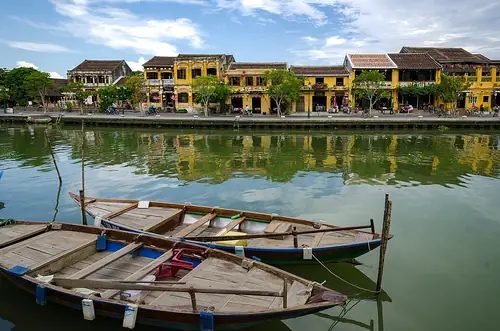
Lantern-lit Old Town, An Bang beach and a cooking class
Getting around Fly the long middle leg: Hanoi to Da Nang is about 1 h 15 in the air, which beats a day on the train.
Hanoi → Ha Long Bay → Hue → Hoi An
Best for A first trip with a bit of everything
- Hanoi 3 nights
Old Quarter, Hoan Kiem Lake, the Temple of Literature and street food
- About 2 to 2.5 h by roadHa Long Bay 1 night
Overnight cruise among the limestone karsts and caves
- Back to Hanoi, then a flight or the overnight trainHue 2 nights
Imperial Citadel and the royal tombs along the Perfume River
- Train to Da Nang (about 2.5 to 3 h), then about 45 min by GrabHoi An 3 nights
Lantern-lit Old Town, An Bang beach and a cooking class
Getting around Fly into Hanoi and out of Da Nang; use the train only for the short, pretty Hue to Da Nang leg.
Hanoi → Ho Chi Minh City
Best for Two weeks with time to spare
- Hanoi 3 nights
Old Quarter, Hoan Kiem Lake, the Temple of Literature and street food
- About 2 to 2.5 h by roadHa Long Bay 1 night
Overnight cruise among the limestone karsts and caves
- Back to Hanoi, then a flight or the overnight trainHue 2 nights
Imperial Citadel and the royal tombs along the Perfume River
- Train to Da Nang (about 2.5 to 3 h), then about 45 min by GrabHoi An 3 nights
Lantern-lit Old Town, An Bang beach and a cooking class
- About 45 min by Grab or local busDa Nang 1 night
My Khe beach, the Marble Mountains and the Dragon Bridge after dark
- Flight, about 1 h 15Ho Chi Minh City 3 nights
War Remnants Museum, Ben Thanh Market and a Cu Chi Tunnels or Mekong Delta day trip
Getting around An open-jaw ticket into Hanoi and out of Ho Chi Minh City means you never retrace a country over 1,600 km long.
Vietnam’s Three Climates and What They Cost
Vietnam does not have four tidy seasons. It has three climate zones stacked along its length, each running on its own calendar, plus a pricing rhythm that mostly follows the European and North American holidays. Knowing which region you are landing in is the whole game.
The North (Hanoi, Sapa, Ha Long Bay)
The north has a genuine winter. From December to February it turns cool and often grey, 15 to 20 C in Hanoi and properly cold in the Sapa highlands, sometimes near freezing. Summer (May to September) is hot, humid, and wet, with the heaviest rain in July and August. The sweet spots are spring (March to April) and autumn (September to November), when the air is dry and comfortable and Ha Long Bay is at its clearest.
The Centre (Hue, Da Nang, Hoi An)
The central coast keeps its own stubborn calendar, and it is the one travelers most often get wrong. It is hot and largely dry from February to August, then flips to a heavy rainy season from September to November, with the worst flooding usually in October and early November. If your dream is lantern-lit Hoi An, aim for spring or early summer, not autumn.
The South (Ho Chi Minh City, Mekong, Phu Quoc)
The tropical south has just two seasons. The dry season runs November to April, hot and sunny, perfect for the Mekong Delta and Phu Quoc’s beaches. The wet season, May to October, brings short, violent afternoon downpours rather than all-day rain, plus thinner crowds and the lowest prices. Temperatures barely move: it is around 30 to 34 C year-round.
How prices move
Peak prices land in December to February (cool dry weather plus Western winter holidays) and around Tet. The cheapest window is the southern wet season, roughly May to September, when flights and rooms soften noticeably.
Month-by-Month Guide to Visiting Vietnam
Use this as your at-a-glance planner before the detailed notes below.
| Month | Weather (overall) | Crowds | Prices | Best for |
|---|---|---|---|---|
| January | North cool, south dry sunny | High | High | South beaches, Mekong, dry north |
| February | Dry, Tet mid-month | Very high at Tet | Peak at Tet | South, central coast, culture |
| March | Warm, dry nearly everywhere | Moderate | Mid | Best all-round month, whole country |
| April | Warm to hot, dry | Moderate | Mid | Beaches, north, central coast |
| May | Hot, south rains begin | Lower | Low-mid | Value, north still good |
| June | Hot, humid, wet south | Low | Low | Cheapest deals, far north hills |
| July | Hot, wet north and south | Moderate | Mid | Sapa green season, summer escapes |
| August | Hot, wet, monsoon peak | Moderate | Mid | Lush landscapes, fewer Western tourists |
| September | Warm, central rains start | Low | Low | Shoulder value, dry-ish north |
| October | North lovely, centre floods | Rising | Mid | Hanoi, Ha Long, north (avoid centre) |
| November | Dry north and south, centre wet | Rising | Mid-high | North and south sweet spot |
| December | Cool north, sunny south | High | High | South sun, festive season |
A few notes the grid can’t capture: temperatures swing by region, from Hanoi highs near 19 C in January up to 28 C by April, while the south holds a steady 32 to 35 C year-round. Tet falls on February 17 in 2026 and pauses the country for roughly a week; July sends travellers to Sapa’s emerald rice terraces, and October turns the north clear and lovely just as the central coast floods (skip Hue and Hoi An that month).
Find Cheap Flights to Vietnam
Vietnam’s two main gateways are Ho Chi Minh City (SGN) in the south and Hanoi (HAN) in the north, with Da Nang (DAD) handy for the centre. From Europe, the cheapest long-haul options usually connect through the Gulf (Doha, Dubai) or via Singapore, Bangkok, and Kuala Lumpur on the budget carriers; Vietnam Airlines and Vietjet also run direct and one-stop routes.
Use the live calendar below to spot the cheapest departure dates at a glance, then compare across months.
Tips for cheaper flights:
- Book 2 to 4 months ahead for long-haul; fares rarely drop last-minute, and Tet sells out early.
- Fly into the cheapest gateway. Sometimes Hanoi or Da Nang beats Ho Chi Minh City, then hop a cheap domestic flight.
- Travel midweek and in the wet months. Tuesday or Wednesday departures in May, June, or September are routinely cheapest.
- Connect through a SE Asian hub. Bangkok or Singapore on a budget carrier can undercut direct fares by a wide margin.
- Avoid Tet. The week around February 17, 2026 carries the steepest prices and fullest planes.
For more route ideas and fare hacks, browse our full flights hub.
Target these windows for the cheapest trips:
May, June, and September are the cheapest stretch. A room that runs 40 US dollars a night in January can drop to 25 to 30, and southern flights fall hardest. You trade some humidity and short afternoon storms for empty temples, green landscapes, and the best deals of the year.
Late spring and early autumn shoulders (parts of April and late September) split the difference: drier weather than mid-monsoon, but prices still below the December-to-February peak.
Steer clear of Tet (around February 17, 2026), the Christmas and New Year period, and the central-coast flood season (September to November, if Hue or Hoi An is on your list) for the lowest rates and least disruption.
Pick your month and the flights look manageable. Next comes the part most first-timers underestimate: how far apart everything is.
Getting Around: Trains, Buses, and Domestic Flights
Vietnam is long, and crossing it the romantic way takes time. The Reunification Express railway runs the full Hanoi-to-Ho Chi Minh City spine in about 33 hours, gorgeous in stretches but slow. Most travelers mix and match.
| Trip style | Best option | Notes |
|---|---|---|
| Single region | Buses and trains | Cheap, scenic, sociable; book sleeper berths early |
| North to south | Domestic flights | Vietjet and Bamboo are cheap; saves days over rail |
| Coastal hops | Train or open-tour bus | The Hai Van Pass stretch is worth doing by rail |
| Mekong / Sapa | Local tours or buses | Roads are slow; factor in extra time |
A domestic flight from Hanoi to Ho Chi Minh City can cost little more than a sleeper-train ticket and saves an entire day, so price both before you romanticise the railway. Grab (the local ride app) and cheap metered taxis cover the cities.
Where to Stay in Vietnam
Where you sleep shapes both your budget and your experience, and Vietnam runs from 8-dollar hostel dorms to riverside boutique hotels. Each base has a very different feel.
| Area | Vibe | Budget room | Best for |
|---|---|---|---|
| Ho Chi Minh City (District 1) | Buzzing, central, nightlife | 20 to 45 US dollars/night | First-timers, food, Mekong launchpad |
| Hanoi (Old Quarter) | Atmospheric, chaotic, walkable | 18 to 40 US dollars/night | Culture, street food, the north |
| Hoi An | Lantern-lit old town, riverside | 25 to 55 US dollars/night | Romance, tailors, beach day trips |
| Da Nang | Modern beach city | 25 to 60 US dollars/night | Beaches, central-coast base |
| Phu Quoc | Tropical island, resorts | 30 to 80 US dollars/night | Beaches, diving, winter sun |
Ho Chi Minh City is the energetic, food-obsessed south. Hanoi is the cultural and culinary heart of the north, with the Old Quarter as a base. Hoi An is the prettiest small town in the country and a favourite slow stop. Compare current rates anytime on our hotels hub.
Daily Budget for Vietnam
| Category | Budget (US dollars) | Mid-Range (US dollars) | Comfort (US dollars) |
|---|---|---|---|
| Accommodation | 8 to 18 | 30 to 60 | 90 to 200 |
| Food (3 meals) | 6 to 12 | 18 to 35 | 50 to 100 |
| Transport | 4 to 8 | 12 to 25 | 35 to 70 |
| Activities | 5 to 12 | 15 to 35 | 45 to 90 |
| Daily Total | 25 to 45 | 60 to 120 | 220 to 460 |
A few notes that keep costs honest: a bowl of pho or a banh mi runs 25,000 to 50,000 dong (about a dollar or two), street stalls beat restaurants on both price and flavour, and Vietnamese iced coffee is gloriously cheap. Long-distance buses and trains are inexpensive, city rides on Grab cost little, and many of Vietnam’s best experiences, from temple courtyards to a morning at a floating market, cost almost nothing.
Stay Connected and Safe: eSIM and VPN
Skip the airport SIM kiosk. A travel eSIM gives you fast data the moment you land at SGN or HAN, which matters when you are booking a Grab in Saigon traffic, decoding a sleeper-train platform, or finding a backstreet com tam spot. Vietnam has cheap, fast, widespread 4G/5G.
- Activate before you fly: data works on arrival
- Plans for 200+ countries from a few dollars
- Keep your number; no physical SIM swap
Hotels, cafes, and even sleeper buses offer plenty of open Wi-Fi, and a VPN keeps your banking and logins private on those public networks while letting you reach your usual streaming and home services. Set it up before you fly.
- Up to 10 devices on one account
- Obfuscated servers for networks that block VPNs
- 30-day money-back guarantee
For the full rundown, see our guides to the best travel eSIM and VPN.
Tours & Activities: Vietnam
Skip the ticket queues and pre-book the best local tours, day trips and skip-the-line attractions.
What to pack for Vietnam
Four picks from our gear guides that suit this trip. Each card opens the live Amazon price; the links below lead to the full comparisons.
A 100% memory-foam U-pillow with an adjustable rope lock at the front, a machine-washable cover, and a 3D eye mask, earplugs and drawstring bag in the box. About 11 x 9.2 x 4.6 in (28 x 23 x 12 cm) and 0.6 lb (270 g). The catch: the neck opening runs large on small frames.
Check price on Amazon Live price on Amazon61 x 122 cm, listed at 120 g in navy, snap loop and a ventilated carry bag. Rainleaf says it absorbs five times its own weight, and it comes in six sizes. The one most travelers should buy first.
Check price on Amazon Live price on AmazonThe reliable all-rounder: three USB-C and two USB-A ports, plugs for 200+ countries, and a built-in fuse with a spare. The adapter most people should buy.
Check price on Amazon Live price on AmazonModel A1259, 10,000mAh, about 37Wh, 215 g. Two phone charges in a jacket pocket, and small enough that the two-bank limit never becomes a question.
Check price on Amazon Live price on AmazonFrequently Asked Questions
What is the best month to visit Vietnam?
March, April, October, and November are the best all-round months, with dry, mild weather in most of the country at once. Because Vietnam stretches over 1,600 km north to south, no single month is perfect everywhere, but these shoulder months come closest.
What is the cheapest time to visit Vietnam?
May, June, and September are the cheapest, with flights and hotels often 25 to 40 percent below the December-to-February peak. You trade some humidity and afternoon rain for thin crowds and the best deals of the year.
When is Vietnam’s rainy season?
It varies by region. The south and central highlands are wettest from May to October, the far north is wettest in summer, and the central coast around Hue and Hoi An gets its heaviest rain and flood risk from September to November.
When is Tet and should I plan around it?
Tet, the Vietnamese Lunar New Year, falls on February 17 in 2026 (Year of the Horse), with the country largely shut for roughly a week around it. It is a fascinating time to witness, but transport books out, prices spike, and many businesses close.
Do I need a visa for Vietnam?
Most visitors need an e-visa, applied for online before travel and now allowing a 90-day stay, while citizens of several countries get a short visa exemption. Check the official portal before you book, as rules change.
How much does a trip to Vietnam cost per day?
Budget travelers manage on 25 to 45 US dollars a day; mid-range travelers should plan for 60 to 120. See the cost table above for the full breakdown.